
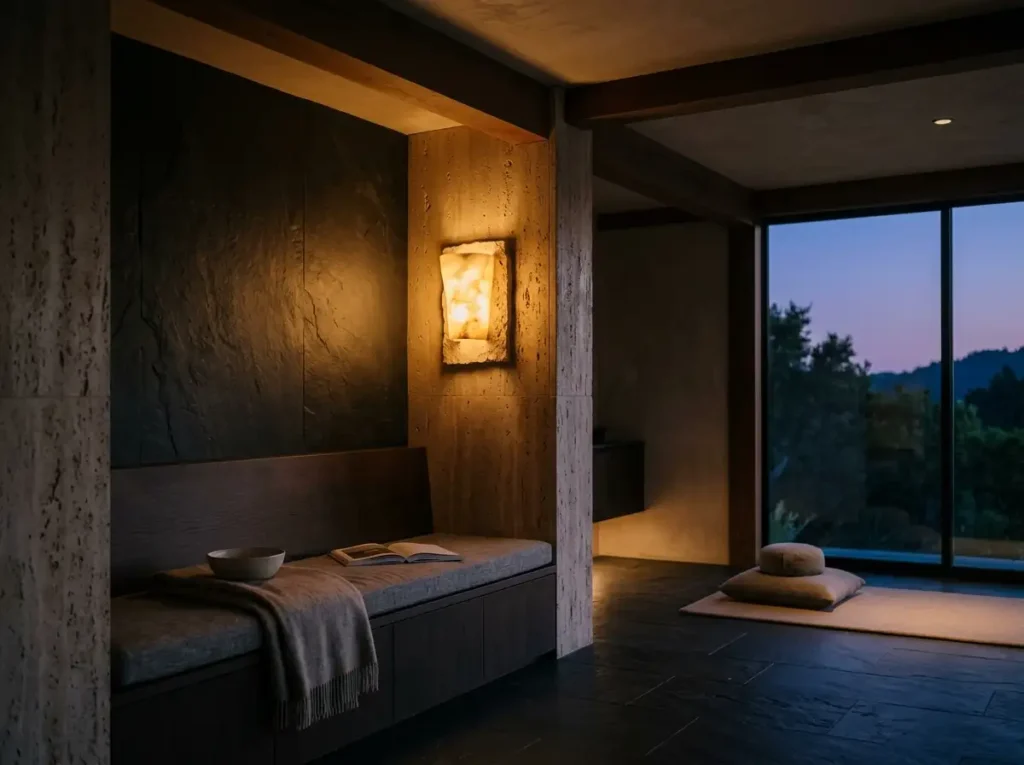
A short study on amber wavelengths, circadian cues, and the architecture of wind-down rituals.
Light is not merely a utility for vision—it is the primary zeitgeber (time-giver) governing human biology. For hundreds of thousands of years, the human nervous system relied on the gradual transition from the full-spectrum blue light of midday to the warm, amber glow of sunset and open fire to signal the end of the active day.
In modern indoor environments, understanding how light wavelengths interact with photoreceptors, hormone secretion, and the autonomic nervous system allows us to design deliberate wind-down rituals that encourage deep physiological recovery.
The Neurobiology of Wavelengths: Blue vs. Amber
The human retina contains specialised non-image-forming photoreceptors known as intrinsically photosensitive retinal ganglion cells (ipRGCs). These cells express the photopigment melanopsin, which is acutely sensitive to narrow blue wavelengths in the 460–480 nm range—the exact spectrum prevalent in natural sunlight, LED displays, and overhead fluorescent lighting.
When exposed to blue-enriched light, ipRGCs send continuous signals to the suprachiasmatic nucleus (SCN)—the brain’s master circadian clock—suppressing melatonin production and maintaining high alertness.
Blue Wavelengths (460–480 nm)  ---> Triggers ipRGCs ---> SCN signals daylight  ---> Melatonin Suppressed
Warm Amber Light (>590 nm)     ---> Minimal ipRGC response ---> SCN signals night ---> Melatonin Synthesis Begins
In contrast, warm mineral light (emitting narrow-spectrum amber and red wavelengths, typically above 590 nm) bypasses melanopsin activation entirely. By filtering out blue-green wavelengths, warm light permits the pineal gland to initiate the natural cascade of melatonin synthesis, preparing the body for sleep without disrupting central circadian rhythms.
Autonomic Shifts: Moving from Sympathetic to Parasympathetic
The psychological and physiological effect of lighting extends directly to the autonomic nervous system (ANS):
- High-Correlated Color Temperature (CCT > 4000K): High CCT lighting stimulates cortisol production and elevates heart rate variability (HRV) metrics associated with sympathetic dominance (“fight-or-flight” state).
- Warm Mineral Lighting (CCT < 2200K): Low CCT lighting triggers a down-regulation of alertness, prompting a shift toward parasympathetic tone (“rest and digest”).
| Lighting Metric | Cool Daylight LED | Warm Mineral Light |
| Color Temperature (CCT) | 5000K – 6500K | 1800K – 2200K |
| Dominant Spectrum | 450nm – 480nm (Blue) | 590nm – 630nm (Amber/Warm) |
| Melanopsin Stimulation | High (Alertness) | Minimal to None |
| Hormone Response | Cortisol maintenance, Melatonin suppression | Cortisol decline, Melatonin release |
| Autonomic State | Sympathetic activation | Parasympathetic activation |
Designing a Science-Backed Wind-Down Ritual
To harness warm mineral light for optimal recovery, structure your environment 60 to 90 minutes before sleep using a tiered lighting strategy.
1. Lower the Lumens and Luminaire Height
Melanopsin-containing ipRGCs are concentrated predominantly in the inferior (lower) region of the retina, designed by nature to detect light coming from above (the sky). Position warm ambient lamps below eye level—on sideboards, floor stands, or low nightstands—to minimize retinal exposure.
2. Transition to Low-CCT Illumination
Replace overhead lighting with warm mineral light sources emitting 2200K or lower. The soft diffusion through natural mineral shades (such as alabaster, salt, or amber glass) further scatters direct glare, creating an even, low-contrast visual field.
3. Pair Wavelength Cues with Tactile Habits
The nervous system thrives on contextual association. Pair your transition to warm lighting with secondary physiological wind-down cues:
- Lowering room temperature to ~65–68°F (18–20°C).
- Engaging in low-contrast, non-screen activities (reading, journaling, or breathwork).
- Utilizing warm-spectrum ambient lighting as an unvarying ritual boundary for winding down.